Introduction
The National Institute for Occupational Safety and Health (NIOSH) released a major update to its List of Hazardous Drugs in Healthcare Settings in December 2024, marking the first revision since 2016. This update brings significant changes in both content and structure, with important implications for healthcare organizations, pharmacy leaders, and frontline staff.
Key Changes in the 2024 NIOSH Hazardous Drug List
- Addition and Removal of Drugs
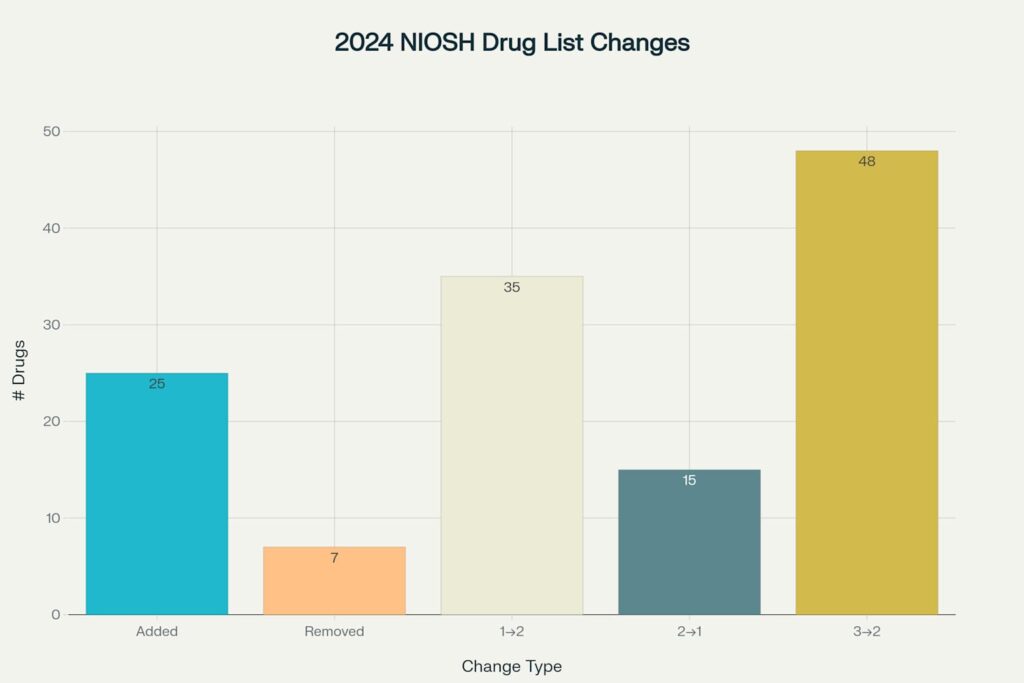
- 25 new drugs have been added, including 12 that come with manufacturer’s special handling information (MSHI)1,4,8.
- Seven drugs have been removed, such as liraglutide (a type 2 diabetes medication) and pertuzumab (an antineoplastic agent), after NIOSH determined that their properties and exposure risks do not pose significant hazards to healthcare workers1,2,6.
- Streamlined Table Structure
- The list has been reorganized from three tables to two:
- Table 1: Now includes drugs with MSHI in the package insert and/or those classified as hazardous by NIOSH, and either as “known to be a human carcinogen” by the National Toxicology Program (NTP) or as Group 1 (“carcinogenic to humans”) or Group 2A (“probably carcinogenic to humans”) by the International Agency for Research on Cancer (IARC)6,7.
- Table 2: Contains all other hazardous drugs that do not meet the Table 1 criteria but still pose risks such as developmental or reproductive toxicity6,7.
- Tables 4 and 5 from previous versions have been removed; supplemental information and historical removal tables are now integrated or referenced elsewhere6,7.
- The list has been reorganized from three tables to two:
- Reclassification and Movement of Drugs
- 15 drugs were moved from Table 2 to Table 1, including some estrogens and estrogen combinations.
- 35 drugs moved from Table 1 to Table 2, and 48 from Table 3 to Table 2, reflecting new criteria for table placement7.
- Not all Table 1 drugs are antineoplastics anymore; some immunosuppressive agents and other drug classes are included based on carcinogenicity or handling requirements6.
- Updated Nomenclature and Classifications
- Scope of Drug Review
- The 2024 update covers drugs approved or flagged with new safety warnings by the FDA between January 2014 and December 2015. Drugs approved since 2016 were not assessed for this update and may be added in the future6.
Changes in the 2024 NIOSH Hazardous Drug List
The 2024 update reduces the number of tables from three to two, streamlining the classification process,1,2,3:
| Table | Criteria for Inclusion |
|---|---|
| Table 1 | – MSHI in package insert and/or NIOSH hazardous drug definition – NTP “known human carcinogen” – IARC Group 1 or Group 2A |
| Table 2 | – All other hazardous drugs not in Table 1 – Includes drugs with developmental/reproductive toxicity (marked in blue) |
Implications for Healthcare Organizations
- Enhanced Worker Protection: Clearer criteria and streamlined tables help ensure appropriate handling and reduce exposure risks.
- Immediate Compliance Required: No lead-in period; update SOPs and staff training now3,4.
- Risk Assessment Updates: Drugs moved between tables may require new risk assessments.
- Ongoing Monitoring: The list does not include drugs approved after 2015; monitor NIOSH, IARC, and NTP updates.
Comparison of 2016 and 2024 NIOSH List Structures
| Feature | 2016 NIOSH List | 2024 NIOSH List |
|---|---|---|
| Number of Tables | 3 | 2 |
| Table 1 Criteria | Antineoplastics, carcinogens | MSHI and/or carcinogens |
| Table 2 Criteria | Non-antineoplastic hazardous | All other hazardous drugs |
| Table 3 Criteria | Developmental/reproductive | Now part of Table 2 |
| Supplemental Info | Yes | Removed |
| BLA Designation | No | Yes |
Conclusion
The 2024 NIOSH update introduces a more streamlined, risk-based approach to identifying and managing hazardous drugs in healthcare settings. With new drugs added, others removed, and a major restructuring of the list’s format, healthcare organizations must act quickly to update their internal lists, policies, and training programs. Regular monitoring of new drug approvals and updated safety data is essential for ongoing compliance and worker protection.