The Miracle and the Manufacturing Maze
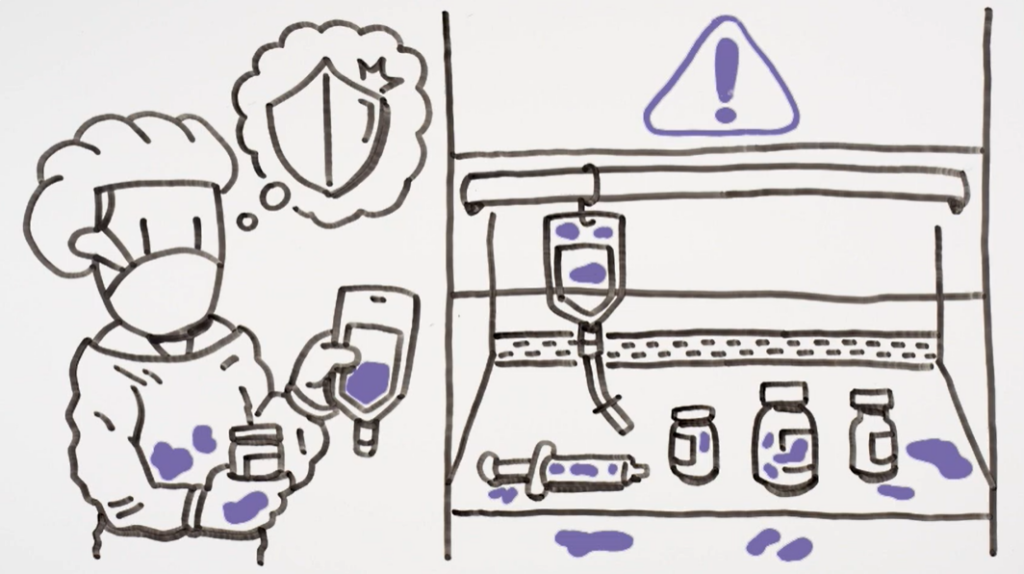
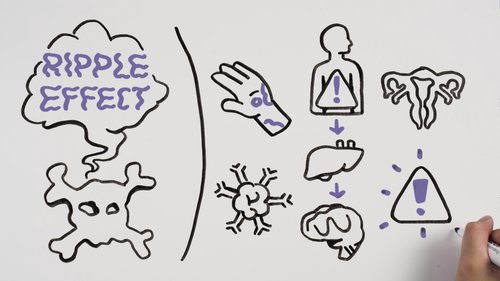
Cell and Gene Therapies (CGTs) represent one of the greatest medical breakthroughs of our time, offering hope against previously untreatable diseases. These treatments, which are custom-built from a patient’s own cells, are nothing short of miraculous. But behind this promise lies an immense and often hidden manufacturing challenge. Developing these personalized medicines is complex, expensive, extremely sensitive and has an ongoing risk of contamination. Understanding these realities is essential for anyone involved in CGT development, scale-up, or commercialization. So, what does it take to create this process, and how are scientists solving a manufacturing puzzle that once seemed nearly impossible?
The ‘One-Patient, One-Batch’ Paradox
The most advanced autologous therapies, like CAR-T cell therapy for cancer, rely on highly personalized approaches tailored to each patient. Manufacturing follows a “one-patient, one-batch” paradigm, meaning the entire production line is often dedicated to a single person. As a result, the process may require a fully single-use fluid pathway and sometimes even a dedicated fermenter for a single treatment cycle. Because these are living medicines, they are extremely sensitive; the cells can be damaged or rendered ineffective by physical stress from equipment or environmental contamination, making the preservation of cell viability paramount.
This creates a paradox. With the average cost to develop a new therapy standing at $1.3 billion1 and individual CAR-T treatments costing over $450,000 per patient2, there is immense pressure to drive down manufacturing costs. Yet at the same time, every single milliliter of the product is invaluable, potentially worth thousands of dollars- requiring a robust and costly approach to production. The core challenge is ensuring absolute protection against product loss and contamination in a fully bespoke process where there is no margin for error.
Sensitivity, Risk Management, and Cost Considerations
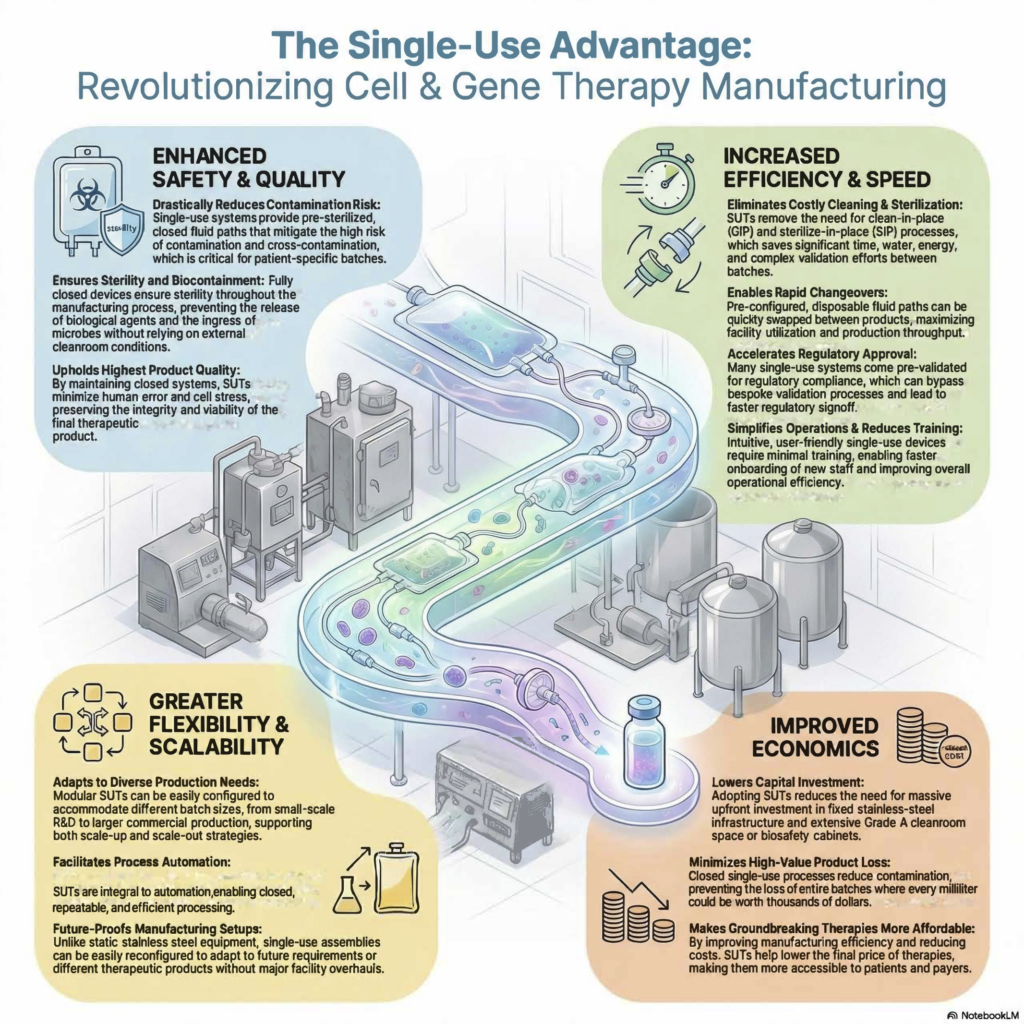
The solution to many of the safety and speed challenges in CGT manufacturing lies in Single-Use Systems (SUSs). These pre-sterilized, disposable systems, including everything from tubing to connectors and bags, replace traditional, reusable stainless-steel equipment.
This approach eliminates the need for laborious, time-consuming, and expensive “clean-in-place” (CIP) and “sterilize-in-place” (SIP) processes required for steel equipment. By simply removing and replacing the entire fluid pathway for each patient’s batch, manufacturers can drastically reduce the risk of cross-contamination and accelerate the changeover from one product to the next. Beyond safety and speed, SUSs provide enhanced flexibility and modularity. This allows multi-product facilities like Contract Development and Manufacturing Organizations (CDMOs) to adapt production lines for different therapies and enables manufacturers to scale from small clinical batches to larger commercial volumes without redesigning entire facilities.
Single-use systems give the option to remove every pathway associated with a batch and replace it with a new pre-validated system.
Modular and Adaptable Operational Flexibility with Speed to Market
While traditional stainless-steel systems are designed for large-volume, single-product campaigns, they are often too rigid for the dynamic needs of CGT manufacturing. Single-use technologies offer a much more flexible, adaptable, and efficient approach.
This flexibility is particularly vital for Contract Development and Manufacturing Organizations (CDMOs) that must support diverse therapies, ranging from autologous to allogeneic and viral vectors using shared infrastructure. Instead of relying solely on “scale-up” (increasing vessel size), SUS allows facilities to “scale-out” by simply adding more units, a strategy that reduces capital investment and aligns production capacity directly with patient demand.
Closed Systems as Part of a Broader Control Strategy
Devices such as EQUASHIELD’s CellSHIELD® are designed to support closed-system principles within CGT manufacturing. When used in suitable applications such as cell sampling, air removal, cell transfer, and more, they help reduce open handling steps and support process control objectives. As with any manufacturing component, performance and suitability depend on the specific process, implementation, and regulatory context. The CellSHIELD® product line is a fully closed, sterile, and disposable device ensuring sterility throughout the cell / gene therapy manufacturing process that provides several unique benefits. It prevents microbial ingress, maintains biocontainment and protects both the patient and the media. It is also designed for intuitive use, requiring minimal training, which reduces the risk of errors and speeds up operations. Its primary advantage, however, is the near-total prevention of product loss.
A leading cell therapy CDMO shared: “We see such low volume loss with CellSHIELD®, that once we switch people over, there really is no comparison. Little to no volume loss, less than 0.1%” 3
From Impossible to Inevitable
While Cell and Gene Therapies continue to mature, their journey from the lab to the patient depends on optimizing manufacturing challenges. Innovations like flexible single-use, closed devices like CellSHIELD® contribute to making these treatments safer, more efficient, and ultimately more accessible. As these technologies continue to advance, we have to ask: what other diseases, once considered incurable, will soon become treatable?