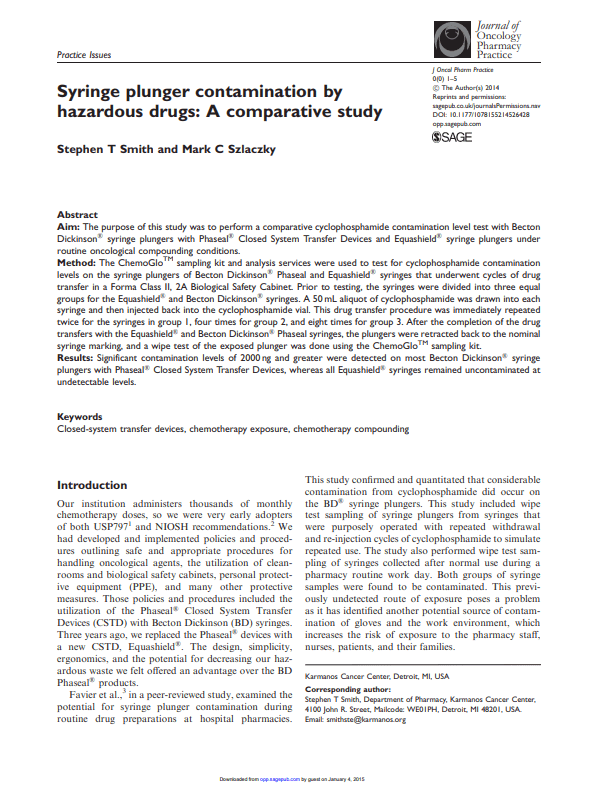
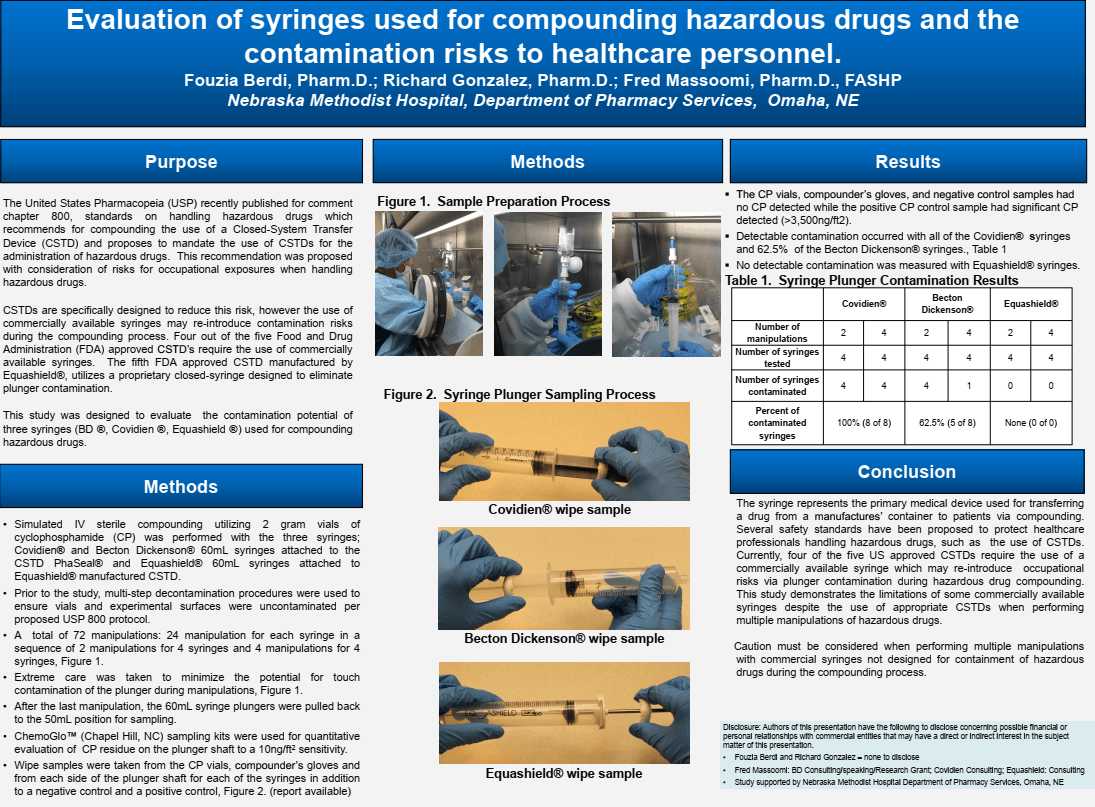
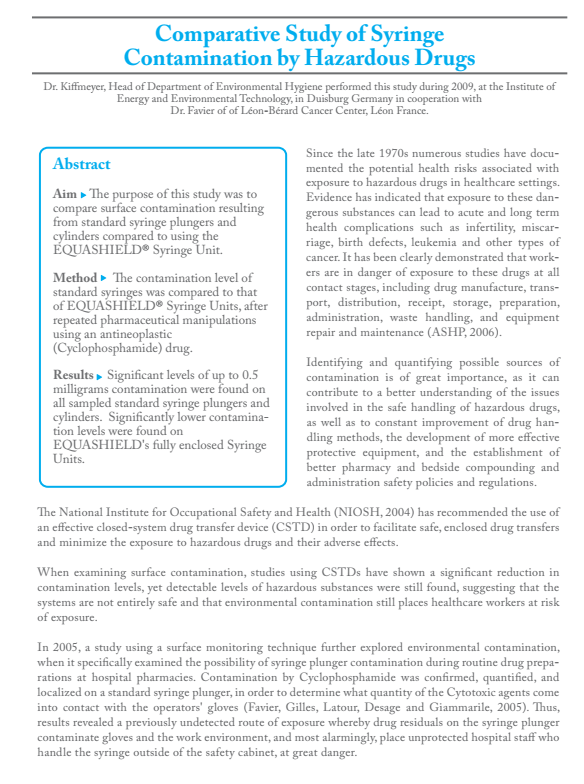
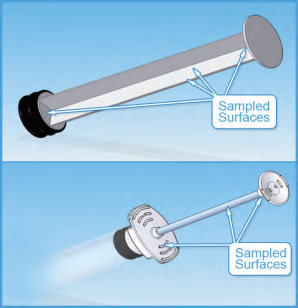
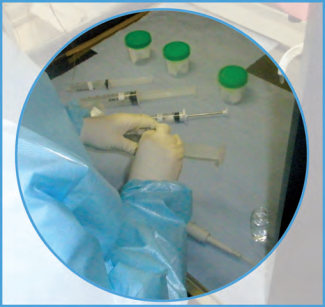
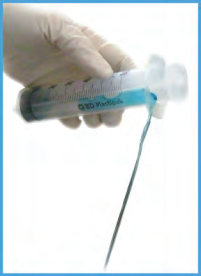
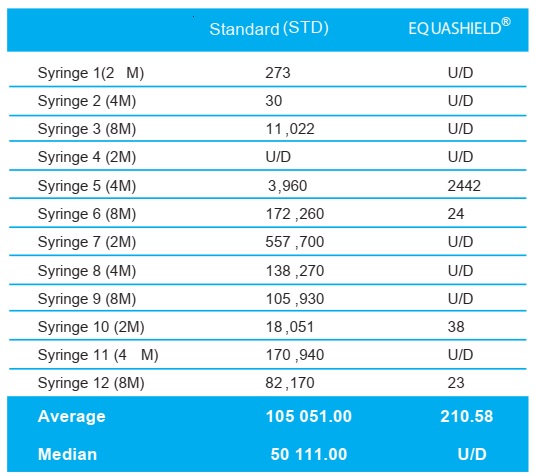
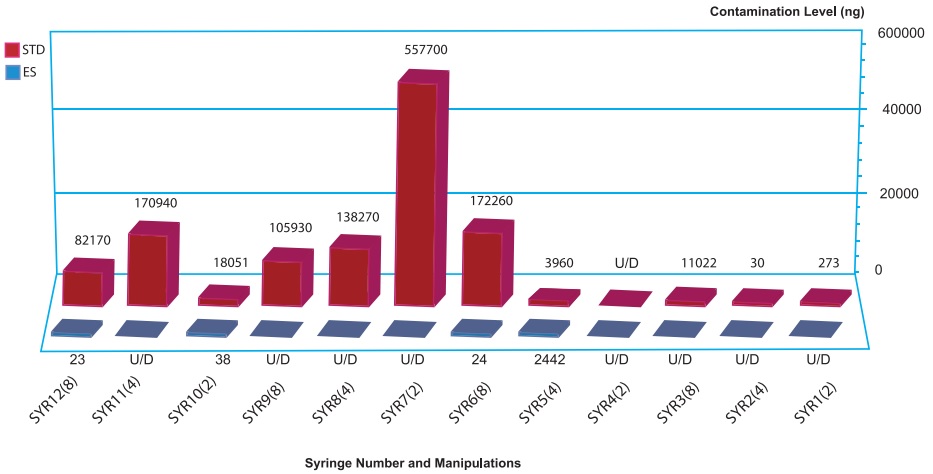
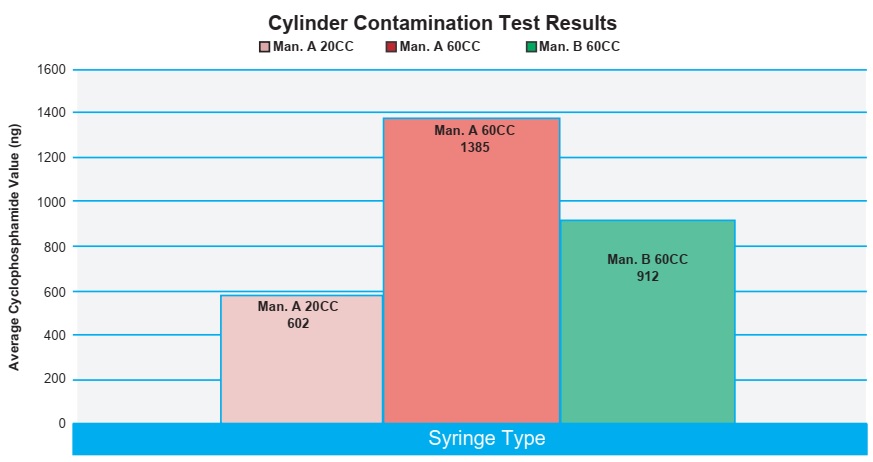
Los resultados revelaron residuos de ciclofosfamida en los émbolos y cilindros de las jeringas estándar, lo que respalda estudios anteriores que sugieren que la contaminación de los émbolos de las jeringas es una vía adicional de exposición que puede contaminar los guantes y las áreas de trabajo durante la preparación y administración rutinaria de fármacos peligrosos en farmacias y al lado de la cama del paciente.
Estos hallazgos también pueden explicar la contaminación de superficies, ya que los émbolos contaminados entran en contacto con los guantes del personal sanitario y, en consecuencia, con las superficies de trabajo, sillas, mesas, etc., a pesar de las diversas precauciones como el uso de guantes, armarios de seguridad y similares. Del mismo modo, los aerosoles y vapores de las jeringuillas pueden contribuir a la contaminación del aire al evaporarse en el ambiente o condensarse en las superficies de trabajo.
Además, dado que los émbolos de jeringa estándar se utilizan con todos los dispositivos de transferencia de fármacos de sistema cerrado (CSTD) disponibles en la actualidad, excepto uno, es importante alertar al personal sanitario de los peligros de utilizar estos sistemas que pueden presentar un problema de seguridad desatendido, lo que resulta especialmente alarmante si se tiene en cuenta el personal desprotegido que manipula la jeringa fuera de la cabina de seguridad.
Por último, es importante señalar que los niveles de contaminación encontrados en los émbolos de EQUASHIELD® CSTD son intrascendentes, lo que indica la eficacia de una unidad de jeringa totalmente cerrada. Esta información puede contribuir al desarrollo de CSTD más eficaces y a la aplicación de mejores políticas y reglamentos relativos a la manipulación de medicamentos peligrosos.
Los resultados indican que la contaminación del émbolo y el cilindro de las jeringuillas comunes utilizadas para la preparación de fármacos es una fuente significativa de exposición que requiere una mayor investigación y consideración. Una posible solución es el uso de jeringuillas totalmente cerradas, como EQUASHIELD®, que ha demostrado reducir significativamente los niveles de contaminación.
Acampora A., Castiglia L., Miraglia N., Pieri M., Soave C., Liotti F., Sannolo N. A Case Study:
Surface Contamina tion of Cyclophosphamide due to Working Practices and Cleaning Procedures in Two
Italian Hospitals. Ann. occup. Hyg., Vol. 49, No. 7, pp. 611–618, 2005
ASHP Council on Professional Affairs. ASHP Guidelines on Handling Hazardous Drugs. American Journal
of Health System Pharm. 2006; 63:1172-93.
Connor TH, Shults, M. And Fraser, MP, Determination of the vaporization of solutions of mutagenic
antineoplastic agents at 23 and 37°C using a desiccators technique. Environmental and Occupational
Health, University of Texas-Houston Health Science Center, 19 Julio 2000. Available online 11
Septiembre 2000.
Connor TH, Anderson, RW, Sessink, PJ, and Spivey, SM. Effectiveness of a closed-system device in
containing surface contamination with cyclophosphamide and infosfamide in an i.v. admixture area.
American Journal Health-Syst Pharm.; 59: 68-72, 2002.
Ensslin AS, Pethran A, Schierl R et al. Urinary platinum in hospital personnel occupationally
exposed to platinum containing antineoplastic drugs. Int Arch Occup Environ Health; 65: 339–42,
1994
Favier B., Gilles L., Latour J. F., Desage M., Giammarile F. Contamination of syringe plungers
during the sampling of cyclophosphamide solutions. J Oncol Pharm Practice 11: 1-/5, 2005
Fransman W., Vermeulen R., Kromhout H. Occupational Dermal Exposure to Cyclophosphamide in Dutch
Hospitals: A Pilot Study. Ann. occup. Hyg., Vol. 48, No. 3, pp. 237–244, 2004
Goloni-Bertollo EM, Tajara EH, Manzato AJ, Varella-Garcia M. Sister chromatid exchanges and
chromosome aberrations in lymphocytes of nurses handling antineoplastic drugs. Int J Cancer; 50:
341–4, 1992.
Hedmer M., Georiadi A., Ramme Bremberg E., Jonsson B. A. G., Eksborg S. Surface Contamination of
Cyclophos phamide Packaging and Surface Contamination with Antineo plastic Drugs in a Hospital
Pharmacy in Sweden. Ann. occup. Hyg., Vol. 49, No. 7, pp. 629–637, 2005.
Hedmer M., Tinnerberg H., Axmon A., Jonsson B.A.G. Environmental and Biological Monitoring of
Antineoplastic Drugs in Four Working Places in a Swedish Hospital. Int Arch Occup Environ Health
81:899-911, 2008.
Kromhout H, Hoek F, Uitterhoeve R, Huijbers, R., Overmars, R. F., Anzion, R. & Vermeulen, R. (2000)
Postulatinga dermal pathway for exposure to anti-neoplastic drugs among hospital workers. Applying
a conceptual model to the results of three workplace surveys. Ann Occup Hyg; 44: 551–60.
Kiffmeyer TK, Kube C, Opiolka S, Schmidt KG, Schöppe G, Sessink PJM [2002]. Vapor pressures,
evaporation behaviour and airborne concentrations of hazardous drugs: implications for occupational
safety. Pharmeaceut J 268:331–337
National Institute for Occupational Safety and Health Alert. Preventing Occupational Exposures to
Antineoplastic and Other Hazardous Drugs in Healthcare Settings. Atlanta, GA: US Department of
Health and Human Services, Public Health Service, Centers for Disease Control and Prevention,
National Institute for Occupa tional Safety and Health, DHHS (NIOSH) Publication No 2004-165; 2004.
Nygren O, Lundgren C. (1997) Determination of platinum in workroom air and in blood and urine from
nursing staff attending patients receiving cisplatin chemotherapy. Int Arch Occup Environ Health;
70: 209–14.
Otto T, Rubben H. (2004) Prevention of bladder cancer. Urologe A; 43: 56–4. Pethran A, Schierl R,
Hauff K et al. (2003) Uptake of antineoplastic agents in pharmacy and hospital personnel. Part I:
monitoring of urinary concentrations. Int Arch Occup Environ Health; 76: 5–10.
Selevan SG, Lindbohm ML, Hornung RW, Hemminki K. A study of occupational exposure to antineoplastic
drugs and fetal loss in nurses. N Engl J Med;1985 313: 1173 8.
Sessink PJM, Cerna M, Rossner P et al. Urinary cyclophosphamide excretion and chromosomal
aberrations in peripheral blood lymphocytes after occupational exposure to antineoplastic agents.
Mutat Res; 309: 193–9. 1994a.
Sessink PJM, Kerkhof MCvd, Anzion RBM, Noordhoek J, Bos RP. Environmental contamination and
assessment of exposure to antineoplastic agents by determination of cyclophosphamide in urine of
exposed pharmacy technicians: is skin absorption an important exposure route? Arch Environ Health;
49: 165–9, 1994b.
Sessink PJM, Bos RP. Drugs hazardous to healthcare workers. Evaluation of methods for monitor ing
occupational exposure to cytostatic drugs. Drug Safety 20:346-59, 1999;
Touzin K., Bussie J. F., Lannglois E., Lefebvre M, Gallant C. Cyclophosphamide Contamination
Observed on the External Surfaces of Drug Vials and the Efficacy of Cleaning on Vial Contamination.
Ann. Occup. Hyg., Vol. 52, No. 8, pp. 765–771, 2008
Tuerk, J. Kiffmeyer, T. K. Kuss, Hahn, H.M. Stuetzer, M. H. Hadtstein, C. Heinemann, A., Eickmann
U. Develop ment, validation and application of an LC-MS/MS procedure for environmental monitoring
of cytostatic drugs. International Journal of Environmental Analytical Chemistry. Accepted for
publication 2010
Turci R, Sottani C, Ronchi A et al. (2002) Biological monitoring of hospital personnel
occupationally exposed to antineoplastic agents. Toxicol Lett; 134: 57–64.
Vandenbroucke, J. And Robays, H. How to protect environment and employees against cytotoxic agents,
the UZ
Ghent experience. Journal of Oncol Pharm Pract 2001; 6; 146.
Wick, C., Slawson, M. H., Jorgenson, J. A., and Tyler, L. S. (2003) Using a closed-system
protective device to reduce personnel exposure to antineoplastic agents. American Journal of
Health-System Pharmacists, Vol. 60, Nov. issue, pp. 2314-2320.